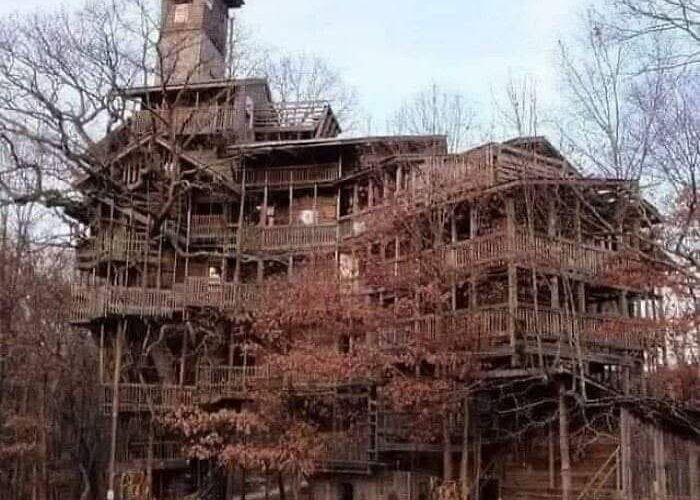
On a quiet stretch of Beehive Lane outside Crossville, Tennessee, there once stood a structure so improbable that visitors drove in from across the country just to see it: a 97-foot-tall, ten-story treehouse, built entirely by hand around a living white oak, with a bell tower poking through the forest canopy. For nearly three decades it stood as one of America’s strangest and most beloved roadside landmarks. Then, on the night of October 22, 2019, it burned to the ground in under fifteen minutes.
Built on a Vision, Not a Blueprint
The story starts in 1993, when Horace Burgess — a landscaper who had already built a smaller treehouse for his son years earlier — was praying at a low point in his life. He later said God spoke to him directly: “If you build Me a tree house, I’ll never let you run out of material.” Burgess took it literally. He got himself ordained as a minister and spent the next several years building without a blueprint, guided only by what he described as a vision of how the finished structure should look.
He never knew, going in, how big it would eventually become. “If He had,” Burgess said of God, “I would’ve tried to talk Him out of it.”
A Structure That Defied Description
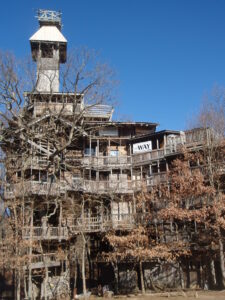
By the time it was finished — or as finished as a project like this ever gets — the treehouse wrapped around a living 80-foot white oak with a 12-foot-diameter trunk, leaning on six additional oak trees for support. Estimates of its size varied over the years, but reporting consistently described somewhere around 80 rooms spread across ten levels, with a working bell tower rising above the canopy. Burgess built almost the entire thing himself, driving an estimated 258,000 nails by nail gun and another 500 pounds by hand, largely using salvaged lumber and construction scraps donated by neighbors. Total cost: roughly $12,000 — a fraction of what any conventional structure that size would require.
It functioned as both a tourist attraction and, fittingly, a working church, drawing thousands of visitors over two decades who climbed its stairwells and balconies free of charge.
Closed by the State, Then Lost to Fire
The treehouse’s informal, faith-built nature ran directly into formal building codes. In 2012, the Tennessee State Fire Marshal closed it to the public, ruling that as a de facto tourist attraction it needed to meet state safety standards it was never built to. Burgess argued there were simply no codes written for treehouses. The gate stayed locked regardless, and the structure sat vacant for seven years, increasingly targeted by vandals despite the closure.
Then, on the night of October 22, 2019, a fire broke out around 10:30 p.m. Firefighters arrived within fifteen minutes, but by then the entire structure — built from decades of dry, reclaimed wood — had already collapsed. The cause was ultimately ruled undetermined. There was no electricity running to the building and no storms in the area that night. When reporters reached Burgess for comment, his response was notably at peace: “I’m okay with it being gone.”
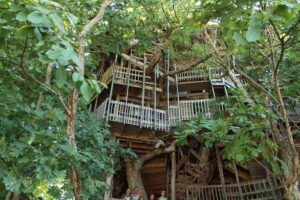
Photo by Andy Melton, licensed under CC BY 2.0
Why It Still Resonates
What made the Minister’s Treehouse more than just a large structure was the story behind it — a self-taught builder, working without formal plans, driven entirely by conviction, who spent the better part of two decades turning scrap lumber into something visitors described as genuinely awe-inspiring. It’s the kind of only-in-America roadside landmark that drew comparisons, only half-jokingly, to a fairy tale — and its sudden, complete disappearance in a single night has only deepened its local legend.
The site on Beehive Lane remains privately owned. The current owner has said he has no plans to clear what’s left of the land, though nothing of the original structure survived the fire.
The Legacy It Left Behind
The treehouse stood on Beehive Lane just outside Crossville for 26 years — from the first nails driven in 1993 to the fire that took it in 2019. In that time, it grew from a modest project into a genuinely massive structure: roughly 97 feet tall, an estimated 80 rooms across ten stories, wrapped around a living 80-foot white oak and six supporting trees, built almost entirely from salvaged and donated lumber for about $12,000 total. Burgess officiated 23 weddings inside its sanctuary, and thousands of visitors from across the country and beyond climbed through it during the two decades it stayed open, before the state fire marshal closed it to the public in 2012 over safety code violations it was never built to meet.
This landmark no longer exists and is not a property for sale — this article is a historical feature on one of Tennessee’s most famous roadside attractions.
