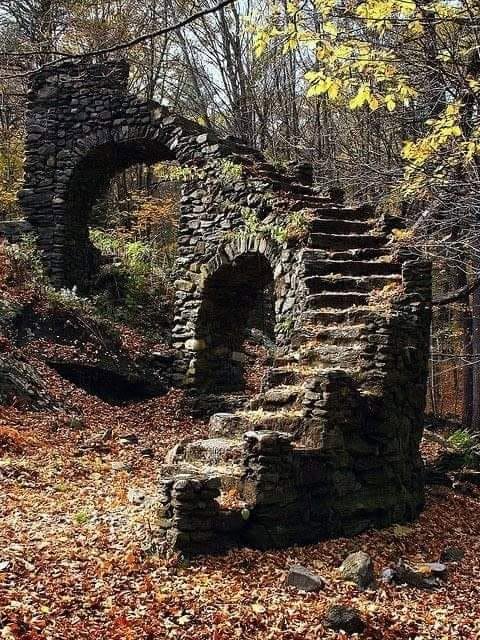
Deep in the woods of Chesterfield, New Hampshire, a sweeping stone staircase rises out of the forest floor, curves upward through a series of stone arches — and stops. There’s nothing at the top. No house, no door, no landing. Just air. The ruins have drawn hikers, photographers, and ghost hunters for more than sixty years, and the woman behind them was, by every account, even stranger than the structure itself.
A Paris-Born Costume Designer with a Scofflaw Husband
Antoinette Bramare was born in Paris around 1878. She danced in trendy French clubs and cabarets under the stage name Antoinette DeLilas before meeting Anthony Macaluso — an American fugitive traveling under the alias “Andre Reila” — around 1909. The couple married and sailed for New York City in 1911, where Antoinette reinvented herself yet again, this time as “Madame Sherri,” working as a costume designer on Broadway, most notably for the Ziegfeld Follies.
After her husband’s death, and funded largely by a wealthy friend and former protégé named Charles LeMaire, Madame Sherri bought roughly 600 acres in the woods of Chesterfield in 1929 and set out to build something entirely her own: a French-inspired chalet, styled with Roman-ruin flair, meant purely as a place to throw parties for her theater friends from the city.
A Castle Built for Excess
By the time it was finished in 1930, the house was genuinely over the top. Floors were covered in furs. Portraits of famous friends lined the walls. Mirrors covered the bathrooms. Outside, the long stone staircase — the same one still standing today — led up to the third floor, which served as Madame Sherri’s private quarters.
Locals had plenty to talk about. Sherri was known to drive around Chesterfield in a chauffeured cream Packard touring car, sometimes wearing nothing but a fur coat, trailing a reputation for parties so wild that the “castle” itself became local legend while she was still alive and hosting them.
From Roaring Parties to Ruin
The good times didn’t last. Around 1957, LeMaire — her main financial backer — stopped sending money, and Sherri’s finances collapsed along with her health. In 1959, the castle was vandalized, its furnishings destroyed. Heartbroken, she reportedly vowed never to return. Three years later, on October 18, 1962, the abandoned house burned to the ground completely, leaving only the stonework: the foundation, the chimneys, and that unmistakable staircase, standing with nothing left to climb toward.
The property was foreclosed on and eventually purchased by LeMaire himself, who sold it in 1965 to Vermont artist Ann Stokes. Stokes visited Sherri in her nursing home to promise she’d look after the land — Sherri died the very next day. Stokes later donated all 488 acres to the Society for the Protection of New Hampshire Forests, which renamed the property Madame Sherri Forest in her honor.
A Ruin That Keeps Changing
For decades, the “stairway to heaven” — as some locals call it — stood remarkably intact, drawing a steady stream of hikers along the Daniels Mountain trail system just off Gulf Road. But the ruin isn’t static. In July 2021, the tallest and topmost stone arch collapsed overnight without warning, an event significant enough to make the Boston Globe. “Gravity is constantly at work, and this is a ruin, so it’s no particular surprise that pieces fell down,” the Forest Society’s president told reporters at the time. The site remains open to visitors today, though the front of the staircase is now roped off for safety, with a trail looping around to the back so hikers can still view the old foundation and fireplace.
Local legend holds that Madame Sherri herself has been spotted sitting atop the staircase in one of her elaborate hats, and that visitors who listen closely on quiet nights can still hear faint music and laughter drifting from the ruins.
Visiting Today
The ruins sit within the 488-acre Madame Sherri Forest, accessible via a short trail near the entrance off Gulf Road in Chesterfield, at the base of Wantastiquet Mountain. Visitors are asked not to climb on the unstable stonework, both for their own safety and to help preserve what’s left of one of New England’s most photographed ruins.
This is a historical landmark, not a property for sale — this article is a feature on one of New Hampshire’s best-known Depression-era ruins.
